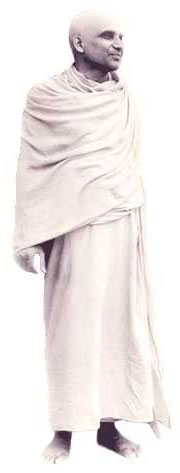
by Swami Krishnananda
Students of Yoga know very well that the movement of the Prana has something to do with the mind, that the mind and the Prana are inter-related in some way, and as such, Pranayama helps control of the mind. Even as the mind and the body cannot be separated into watertight compartments, the Prana and the mind also cannot be so isolated. In a way, we may say, that the Prana is just the movement of the mind. It is the flow of the mind in a particular direction. It is the energy of thought that operates in an externalised manner. It is the direction of the individuality in terms of externality. That is the Prana. In other words, the force with which the mind moves outwardly is Prana, truly speaking. Prana is only a force. When a dam bursts and the water rushes forth, the water moves with a force. This force with which the water moves may be compared to the Prana, and the water itself to the mind. Now, this force of the water cannot be separated from the water itself, though it cannot be said that the force is the water. Logically, they are two different things. Yet, practically they cannot be separated. Only a theoretical or a logical distinction can be drawn between the force of the water and the water. Likewise, a distinction can be drawn between the Prana and the mind also. But really, they are the same. To control the water, one has to control its force. Even so, to control the mind, one has to control Prana which is its force. "Pranaspundaha nirodhah" is one of the methods of restraint of the mind.
Why does Prana move with such a force or velocity? Why does the water move? The water moves, because the sluice gate is open in the dam. There is a passage open for the water, and therefore, it rushes. So also, Prana moves outwardly, because it has found an avenue of expression, an outlet of expression. This avenue, this outlet, should be blocked, and then the force will be contained. The avenues are the senses. They are the apertures through which the power of the mind rushes out in the form of the Prana externally. Thus, we have an inter-relationship between the mind, the Prana and the senses. The channels of the senses are the passages through which the energy of the mind rushes out as the Prana in terms of the objects outside. So, when we try to restrain the mind in the practice of Yoga, we may have to take a number of all-round steps, and not just one step. The senses, the Prana and the mind form one group, and they are so friendly with one another, that it is impossible to restrain one without also putting down the powers of the others. It is something like catching a gang of dacoits or thieves. We cannot catch only one of the gang and feel mighty pleased that everything is okay. Because, there are the others, who are the associates of the captured thief, and who are still free to play havoc.
Inasmuch as the senses move in terms of the objects outside, their vehemence depends upon the nature of the objects, the proximity of the objects, and such other considerations. Therefore, the practice of Yoga in the form of mind control may have to take into consideration the atmosphere in which one lives. In the exercise of mind control, we thus gradually move from the inward points of the mind to its relationships outside, even into the society externally, so that it is a very vast affair, and not merely a single act of just stopping the breath, or thinking of a single object. That is why the practice of Yoga is supposed to be commenced in a proper external atmosphere, in a right environment, though essentially it is a mental operation finally. As far as possible, one should not physically place oneself in an atmosphere either of temptation or of violent hatred. There are things which we hate for reasons of our own, and also there are things which violently attract us, again for reasons of our own. It is wisdom on everyone's part, therefore, not to place oneself too much in the midst of those things which will pull one's mind violently, either positively in the form of love, or negatively in the form of hatred. One should therefore try to go to sequestered places, as far as possible. It does not mean that physical isolation is a remedy for the desires of the mind. Just as a drug or a medicine acts better on the body when the body is cleansed by prior fasting, control of the mind becomes a little easier when it is not physically placed in an atmosphere of untoward attraction or repulsion.
We have already seen that the way in which the mind acts upon the object is the Vritti. And the Vritti differs from person to person, because a particular object may not evoke a uniform reaction in the case of all individuals. So, finally, there is individual detail involved in the control of the mind, though, generally speaking, we may say that all objects are to be weaned away from mental operation. The mind has been accustomed to imagine that there is great value in its connection with objects. It has been educated into this system of thinking. Otherwise, it will not be thinking of anything at all. The first and foremost duty of a student of Yoga in this connection would, therefore, be to educate the mind with regard to its proper relationship with the objects.
What is the reason behind the mind thinking of an object? The reason is a certain pleasure that accrues to the body, the senses and the mind also, from the so-called contact of itself with that object. In one aphorism, Patanjali tells us that here is a great misconception on the part of the mind that some pleasure comes from the object. The mind is deluded when it thinks that joy is the consequence of contact with the object. It is deluded, because the consequence of the mental contact with an object is not pleasure, according to the author of the Yoga Sutras. Not only the consequence that follows subsequently, but even the imagination that there is a pleasure in the object at the moment of contact is a misconception. The mind may say: "Even if there is some pain following the contact with the object, what about the present satisfaction? Why not suffer the chaff though it is unworthy, and have a kernel of satisfaction, a kernel of joy, even if it be for a moment?" But then, even this momentary satisfaction at the time of contact is not a real satisfaction: it is a delusion. This is told us very interestingly. The joy that appears to arise in the mind at the time of its contact with an object is due to the operation of Prakriti in a very mischievous manner. When we come to know how this mischief is worked by the Gunas or the properties of Prakriti, we realise to our surprise that we are not living in a world of joy at all.
There are three modes or Gunas of Prakriti-Sattva, Rajas and Tamas. Sattva brings about an equilibrium of the forces of which Prakriti is constituted. Rajas distracts this equilibrium; and Tamas overpowers the other two properties, namely, Sattva and Rajas, so that there is a sort of unconsciousness when Tamas prevails. We are unconscious when we are asleep. In sleep, Tamas is predominant; Rajas and Sattva are overpowered completely. When we are busily working or thinking something outside, we are in Rajas. When we are happy, a little of Sattva operates in us. Now, what is this little happiness? This remains to be explained. In Tamas, there is of course no experience at all. So, we have very little to say about it. We are concerned with experience, whether it is a desirable one or an undesirable one, painful or pleasurable. Inasmuch as in Tamas there seems to be no experience whatsoever, we have nothing to say about it practically. It is a totally unworthy state. In Rajas, the mind is disturbed, and thrown out of its balance. In this condition, the mind is charged with the force of consciousness. We have already stated that the mind is the way in which consciousness moves outside in terms of objects. The Purusha is beholding itself, as it were, in the Prakriti, the object outside. So, when the mind is disturbed by the activity of the Rajas of Prakriti, on account of which it moves towards the object, it is followed by the consciousness of the Purusha. This is something which requires a little bit of imagination to understand. When a force is ejected out, it is also charged with an intelligence which makes it aware that it is moving. This force that is aware that it is moving towards an object is the mind, though the awareness does not belong to the force. The mind is not consciousness, Prakriti is not Purusha, as the Yoga tells us. But we, somehow or the other, get into a muddle, and consciousness thinks that it is the force and there is a pulling out of oneself outside oneself, an alienation; an aberration, a moving away of self from itself to the object. The Purusha becomes the non-Purusha for the time being.
Joy is the condition of the Purusha. Joy is nothing but illumination of the Purusha in itself, resting itself in itself, and not getting pulled in the direction of something outside. But, every desire is a pull externally. So, when a desire manifests itself, which is the reason for the movement of the mind in terms of objects outside, the Purusha ceases to be itself for the time being. Nothing can be worse for one than to cease to be what one is. It is a loss of self-consciousness. The subject forgets itself and becomes the object, as it were, for the time being. For the time being, the crystal becomes the flower, as it were. The subject becomes the object of love as it were and clings to the object as if he were that. Now the sorrow that attends upon the movement of a desire in terms of an object is nothing but this loss of self-consciousness. Self-consciousness is joy; the loss of it is sorrow. The Purusha becoming the Prakriti is the sorrow of Samsara, and that explains all desires, everything that we do here. So, Rajas works a havoc by completely overpowering the self-consciousness of the Purusha and compelling it to move towards the object, which is apparently there outside, and making the Purusha feel its presence in the object. This is what happens to us when we love anything intensely. We find that we are there, and we have lost ourselves completely here. So we cling to things. This is a great mistake and very easily detected.
The joy that follows from the satisfaction of a desire is not the result of the contact of consciousness with the object, but the result of the return of consciousness to itself, under certain circumstances which prevail on the fulfilment of a desire. The essence of' the matter is that the mind is under an illusion when it imagines that it is necessary to move towards an object for gaining a satisfaction of some kind. Satisfaction does not come from this contact. To give a gross example: The relief that we feel by scratching the itching skin is not the result of scratching merely, though it may appear that scratching gives some relief and joy. The relief comes due to the movement of blood to that part of the skin which, somehow or the other, was previously bereft of that blood supply on account of the malady of the skin. The activity of scratching is not the cause of the satisfaction; the movement of blood is the cause. Something like this happens in the mind itching for objects of sense. The satisfaction that one gets by means of contact with a sense object is something like the satisfaction that one gets by scratching the itch. The scratching does not bring the relief. Likewise, the contact of the mind with the object does not bring the joy. The joy is due to a resting of consciousness in itself, due to Purusha resting in itself, as a consequence of the cessation of this activity of coming in contact with the external object.
The Gunas of Prakriti, therefore, have a great role to play in this movement of the mind towards objects and involving the Purusha in a sorrowful experience. There is a sort of anxiety in the mind before it comes in contact with a desired object. And anxiety cannot be equated with any joy. There is anxiety even at the time of the so-called satisfaction by means of contact. That anxiety also cannot be equated with real joy. There is anxiety of a worse type after the satisfaction is over. So there are sorrows – before, in the middle, and afterwards. A man who runs after wealth wants to make a lot of money. In the beginning, he is anxious about the ways and means he has to adopt in amassing wealth. So, at that time, he is very unhappy. When he possesses the wealth, he is anxious: "How will I keep it safe? How may I not be robbed of it? How long will I keep it and how long will it be with me?" This is the anxiety. The man is not happy even when the wealth is there with him. Restless is the mind of rich people for reasons they only know. When the wealth is gone, man is in hell almost. "Where is the joy in this world?" asks Patanjali, "Neither in the beginning, nor in the middle, nor in the end". "Parinama-tapa-samskara-dukhair guna-vritti-virodhaccha duhkham-eva sarvam vivekinah": This is the Sutra (II-15) of Patanjali. Due to the consequence that follows, Parinama, the agony that is there attending upon every type of experience in the contact of the mind with objects, is Tapa. And the impressions of desires getting accentuated again and again and wanting a repetition of the act, cause further agony; which is Samskara Duhkha. And lastly, due to the subjection of consciousness to the operations of the Gunas of Prakriti, due to its becoming a slave to the operations of Prakriti, it ceases to be a free entity. How can slavishness be identified with satisfaction or freedom? For all these reasons, for a person of discrimination, the whole world is sorrow only. There is no joy anywhere. Therefore, tell the mind: "My dear mind! Do not be misguided. Do not be in a state of illusion. Do not get deluded by the notion that this world of objects is going to give you any joy. If the world is not going to give you any joy, why do you think of the world?" The mind will then understand: "My thought of the world itself is senseless and has no meaning. No joy can accrue from anything outside, by any means of contact". All contacts are wombs of pain – this is a famous saying. And the mind's thought of an object is nothing but a contact. Therefore it follows that it is necessary to withdraw the mind from all contacts with things. This is a little bit of education to the mind.
Nothing is more effective than education. Nothing need be told afterwards. If a person is properly educated, he will know what to do. It is lack of sufficient education that makes one feel that he requires instruction from outside. On the other hand, when a person is himself illumined, he needs no instruction, because he knows what to do. So, before trying to do anything in the direction of control of the mind, we have to be educated in the direction of proper understanding. This is what this Sutra seeks to achieve in a little way by a little admonition. But, even after we have known all this, even after we have an understanding of our situation intellectually, our instincts will have their own say once again. This is because the instincts are more vitally connected with the stuff of the mind than the ratiocinating faculty. However much we may argue intellectually and be convinced about the truth of things, our feelings will not yield like that so easily. A philosopher knows to some extent the nature of the universe, but that knowledge does not help him in his daily life, because his feelings have not been influenced adequately by his analysis, philosophically done. The instincts are very strong, and whatever may be one's acumen acquired by a scholarly education, it does not help when it comes to the question of practice in daily life. For this purpose, a vital education has to be imparted to the mind, apart from merely an academic or an intellectual education. Such a vital education was very effectively imparted to students in the ancient Gurukulavasa, in the Gurukula system of education. In the modern systems of education, this vital education is not there. We have intellectual education, but nothing by way of a vital, emotional education imparted to the very stuff of the individual, with the result that the stuff of the individual has remained the same as it was before. It has not been affected in any manner. The outlook of life does not change after getting educated in a college. The individual remains the same even after that. But, in the Gurukula educational system, the outlook change was effected. The student became a different person altogether when he came out after a period of training under a master. Today, we have no personal relationship between the student and the teacher. There is a sort of commercial relationship, which is almost the death of education. Even that relationship is now snapping. There seems to be no relationship at all between the student and the teacher these days. The whole framework is crumbling and we do not know where we are heading towards. But, in earlier days, the teacher was like a father to the student. The Guru, the teacher, the instructor or the professor was also a parent who had the welfare of the student in his mind. Which professor has the welfare of his student in his mind today? The teacher of today does not care a bit for the student. So, the soulful contact of the teacher with the student, which was available in ancient days, being lost these days, we are in an unfortunate condition. We find it very difficult to get on.
The influence of the teacher on the student is very important. The instruction that the student receives from a teacher verbally is one thing. Perhaps the student can have that instruction even from other sources, in schools and colleges. But, the benefit of the influence of the teacher cannot be gained from other sources. When the Guru speaks to the disciple, when the Yoga teacher instructs the student of Yoga, the soul of the Guru or the teacher makes an immediate impact on the mind of the disciple. This is because the teacher of Yoga is not just an ordinary person. He is not just another Tom, Dick or Harry. He is an exceptional person, exceptional in every way. The Yoga teacher is not an ordinary human being. He is one who has passed through the various stages of Yoga training and acquired the competency to teach on account of his own personal practice. This is very important. Unless one has himself practised Yoga, he cannot teach Yoga. It is neither possible nor desirable to read one book and then start teaching. It is the very practice of Yoga which is the strength of the Yoga teacher, which gives him the confidence to communicate vitally with the student. When this is done, a rapprochement is established between the will of the teacher and the will of the student, because of a mutual agreement of ideas and ideologies between the two. The student surrenders himself to the teacher, wholly and solely, and the teacher takes on the responsibility of looking after the welfare of the soul of the student, and not merely his intellect. This is another very important factor which helps the student of Yoga in his practice of mind control.