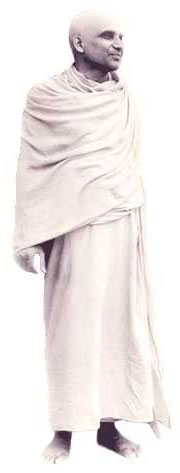
by Swami Krishnananda
The Yamas of Patanjali are not moral instructions. They are not even ethical disciplines in the ordinary social or political sense. They are scientific, logical, philosophical. The nature of the Purusha is such that it cannot permit of attitudes of exploitation, even attitudes of love and hatred, because these are the outward manifestations of consciousness in the direction of its own bondage. That is precisely why Patanjali emphasises the Yamas as a very essential step in the practice of Yoga. Though the perfection in Yamas can be attained only in the ultimate union with the Purusha, an earnest beginning has to be made by every seeking soul in the conscious practice of the Yamas. The philosophical requirement behind the practice of the Yamas can be fully realised only in the end. In the earlier stages, it would not be possible. But, an endeavour has to be made, even in the earlier stages, to conform one's attitude and behaviour in daily life, and in society, to the requirements or canons of the Yamas of Patanjali.
We can stop the movement of a watch either by holding the hands or the pointers, or holding the cog inside. The practice of the Yamas in the advanced stages assumes the form of controlling the inner mechanism itself. But, the lower practice is something like holding the pointers of the clock, at which time the cog also stops functioning. It is only a tentative measure to stop the clock, and not a final remedy, because when the fingers are lifted from the pointers, the cog will move again. But, if the movement of the cog inside is arrested, then the other manifestations of the cog's movement also cease automatically. Likewise, in our practice of the Yamas, we have to develop a double attitude of outward control as well as inward understanding. We should not hang only on one side. When we try to discipline ourselves inwardly, psychologically or philosophically, we should also adopt an external measure of self-control, by placing ourselves in such social circumstances, where we would not be compelled to break this requirement of the canons. That is why usually a student of Yoga resorts to places and atmospheres, where he would not willy-nilly be compelled to break these disciplines. The sequestration to holy places, and resort to hilltops, monasteries, temples and forests is done with this intention only.
Even then, outward practice will not be highly or wholly successful if the mind is not agreeable to the practice. So, a philosophical discipline of the mind is very important, together with the outward practice of self-control by way of isolation of oneself in a suitable geographical atmosphere. It is difficult to say which comes first, and which comes second-outward control or inward understanding. Perhaps, they go together. The inward and the outward disciplines should be carried on simultaneously almost. So, one has to be vigilant at all times. Vigilance is Yoga. A balance has to be struck between our outward conduct and our inward intention. And so, one has to be very careful at all times to see that there is no rift, no contradiction, between our inward behaviour and the outward conduct we manifest in society. We should not be thinking something inside, doing another thing outside. The doing outside should have some meaning in connection with the intention that is in the mind. So, it becomes a little difficult for a beginner in the earlier stages to understand how he can live in this world at all.
A mere instruction from somebody will not be sufficient for the beginner, because nobody is prepared to receive instructions from somebody else. Every mind resents advice from other people, for reasons which are personal, social, and also philosophical. Everybody has a self-respect and self esteem, which it is that dislikes any kind of advice from outside. But, it is different in the case of a person who has awakened himself to the need of listening to advice coming from higher realms with a larger sweep of inclusiveness, such as the advice coming from a master or a Guru, which cannot be regarded as an advice coming from outside. Because, the Guru is not a person who is outside. The Guru is a stature of consciousness, a transcendent status, which is above the disciple and not outside the disciple. The Guru is not a person standing outside the disciple, and so, the latter should not think that the Upadesha or advice coming from the Guru is an instruction coming from an external source. But, these are again difficult things for the mind to grasp, because we have not been educated to think on these subtler lines. We have a very gross way of thinking, which is acceptable to our usual instinct of selfishness.
Every person in the world is as valuable as everyone else. This fact must be accepted first of all. We cannot imagine that somebody is inferior to us and is only a food for our instincts. No man is meat for another man. This is the fundamental instruction in Yoga, which explains the principle of Ahimsa also incidentally. No man is a servant of another man. This point should not be forgotten. And, therefore, one should not shout, "Hey, servant!" and all that. These shoutings have no meaning ultimately. One appears to obey the dictates of another person under the pressure of circumstances, but that obedience does not emanate from the bottom of his heart. Everyone loves oneself and no one is prepared to bow down to the orders of another person, unless this order comes from a higher source. So, inasmuch as there is a sanctity in every individual, life is sacred. "You cannot kill" is the great teaching of the masters of religion, the prophets of spirituality; "Thou shalt not kill." Thou shalt not kill is a principal canon in all religions, because one would not like to be killed. Is it not true? If one would not like to be killed another also would not like to be killed! Should we not understand this much of psychology? How could we imagine that another can be killed and we alone should be set free? This injudicious affirmation of oneself cannot brook acceptance from the laws of nature. Nature reacts to any interference with its balance of laws. And exploitation of any individual, in any manner whatsoever, which turns gross into palpable injury, will set up a reaction from natural sources, perhaps a reaction with a greater intensity, and the man who exploits and injures will be paid back in his own coin. He may have to take birth again to receive his punishment. Perhaps, he may have to be punished in this birth itself, if his action was very intense. So, the Yoga student should be careful not to break the laws of nature when his intention is something noble and sublime and superb, which is the realisation of Yoga. "Harm not any creature" is another way of saying, "Break not the laws of nature".
What is nature, but an integration of values and a totality of lives, as a cosmopolitan society, where no one belongs to another? Nothing is a property of any person. There is universal democracy, something far superior to our own limited notions of democracy. In a system of things where everything hangs on something else, everything is dependent on everything else, nothing is independent. Where nature is such a vast integration and completeness of interdependence of parts, no one is a master, no one is a servant. And, therefore, it follows that no one can love and no one can hate, because no one can possess and no one can be dispossessed. These are deeper truths, into which we are driven by the force of facts, by a study of the philosophical significance of these instructions of Patanjali on Ahimsa, Satya and other Yamas. While the linguistic meanings and social bearings of these teachings are well known, the deeper aspects of these instructions are not visible to the eyes and are not apparent even to the mind ordinarily.
What is the deeper import of Ahimsa? One has to be a friend of all. This is the meaning, the purport, of Ahimsa – Sarva bhuta hite ratah, in the language of the Bhagavad Gita. A friend of all can hurt nobody, when he is intent on the welfare of all beings. As we would like that others should be our friends, the others also expect that we should be their friends. Broadly, here is a very interesting meaning hidden behind the great canon of Ahimsa, which is translated everywhere as simply non-injury. Truthfulness is very simple and very easy to understand, because untruth is nothing but exploitation. Finally, all these hang upon the central attitude of exploitation of individuals by individuals. One would not utter a lie, unless one wishes to exploit somebody. So, it is very clear as to why one should not utter a lie. If one person could utter a lie to another person, that other person also can utter a lie to the former. Why not? So, one will be in the same condition as the other, both having tried to deceive each other by their untrue behaviour.
The other two complementary aspects of this instruction of Patanjali are Asteya and Aparigraha, namely, non-stealing and non-acceptance of articles or possessions which are not necessary for one's existence, to put it broadly. Because, while we are permitted to live in this world, while we have the sanction to exist in this world by the orders of nature, we do not have the sanction to accumulate goods which are not necessary for our sensible existence in this world. Otherwise, it becomes theft, because we will be depriving others of their needs by accumulating articles beyond, the requirements of our own individuality, under the circumstances in which we are placed in society. We cannot exploit individuals. It is very clear. And we cannot exploit the world also. We should not exploit God Himself finally. Many a time our prayers to God assume the nature of exploitations only whenever we try to grab something from God. We should not grab anything from anybody, and we cannot expect from this world anything more than what we have given to the world as our share of service. The world is a system of mutual co-operative activity. If A cannot co-operate with B, B cannot be expected to co-operate with A. This is purely sense and reason. Therefore, we cannot expect the world to co-operate with us, if we are not prepared to co-operate with it in a similar manner. Therefore, we cannot demand things from the world, which we have not given to it by way of co-operation, in one way or the other. One has to learn to co-operate with the world in every one of its stages of manifestation – socially, physically, psychologically, rationally, politically and spiritually – because, Yoga is a total union of oneself with the totality of things.
We have to be in tune with all the layers of nature, which makes it a little difficult for us to practise Yoga. The discipline of Yoga is a hard job, because it requires a great adjustment, a minute adjustment, an utterly precise adjustment, such as is required in the manufacture of a computer system or a robot or a subtle instrument. This requires extraordinary concentration. Else; anybody would be a Yogi in this world, if it had been so simple! The all-round aspect of this adjustment, the comprehensiveness of this Yoga attitude, makes it a difficult task for a lay-man to think of Yoga itself, though outwardly he may endeavour to move in its direction by external sacrifices and austerities of some kind or the other.
True, Yoga is a hard thing, until the mind is properly educated in this new science. Self control, as mentioned earlier, is Yoga. And some of its features are set out in the canons known as the Yamas. The Yoga practitioner will find himself always in a difficult predicament in trying to practise any of these canons. They are not so easy as that. The Yoga student may think that he has understood everything, but he will not be able to put it into practice, for reasons he should find out for himself. It is almost impossible to practise Ahimsa, or Satya, or Asteya, or Aparigraha, under normal circumstances, unless one strains oneself hard with some effort, especially in the earlier stages.
Many times, Yoga is identified with renunciation. Yoga, they think, is to become a monk or a nun; Yoga means entering into a monastery or a nunnery or a chapel or a temple. It is something totally opposed to the normal life in the world. This is the way in which people usually understand Yoga these days, perhaps at all times. But here again, we have to strike a note of caution. Any kind of over-enthusiasm or over-estimation is not called for in Yoga practice. Yoga is a gradual ascent and not a sudden jump. Nature evolves and does not set up a revolution at any time. The growth of a tree is gradual, evolutionary and not revolutionary. There is no revolution anywhere in nature. So, the Yoga student cannot set up a revolution in himself thinking that he will overnight become a Yogi. Yoga is a gradual growth and maturing of one's personality by a systematic adjustment of oneself through every stage of its progress. And so, words like renunciation and relinquishment, monk and nun, are only certain slogans which carry no meaning finally. Slogans are not going to help anyone finally. One has to be very matter-of-fact here, and realistic to the core, and not foolishly be an idealist in an ethereal world. The world is not going to leave anyone so easily. It has already embraced us all. And the world's embrace is like a bear's embrace, very hard. We are under the world's clutches, and to extricate ourselves from the clutches of this world – bear, intelligent practice is called for. That practice is Yoga.
Yoga does not mean renunciation, as renunciation is generally understood. Yoga does not mean entering into an order of monks or nuns, if by this is meant a relinquishment of the duties of the world and the ways of life as they are normally lived. Religions today are slowly crumbling down at the base and everyone knows the fate of religions these days. And if one reads the history of religions, right from the ancient Palaeolithic age onwards, one will find that religion has had a hard time every now and then, and it has not always been successful, as it has been well demonstrated in the history of the church, for instance. Time was when the Pope was the king of the whole of Christendom. And every king of Europe was a slave, as it were, of the Pope. And the Pope's order was God's order, and the Church was the king, and the secular rulers were expected to obey the mandates of the clerical order issuing forth from Rome. It went on like this for some time, and only for some time, because history moves in the form of a cycle, and as the spokes of a wheel go on rotating, some spokes go up, some spokes come down.
There was a time when religion held sway over everything else, but this did not live long. Because, oftentimes religions go to the extreme of affirming an other-worldly salvation of the soul and this emphasis, which is often laid in religions on the other-worldliness of spiritual achievements, has been the cause of internal distress in the minds of individuals. This sort of religion is not a friend of the world, but an enemy of the world. It hates the world, condemns the world as a devil, as an evil, from which one has to run away as early as possible, because one's welfare is in the other world, and not in this world. Though the intention of religion was not, and is not, to proclaim a doctrine of this type, somehow it stumbled into this attitude, for a peculiar reason, which we have to study by going deep into the psychology of religious practice. But, Yoga is not religion. It is not any kind of religion that we are acquainted with in this world. It is not Hinduism; it is not Buddhism; it is not Christianity. It is a philosophical discipline. And philosophy is not Christianity; it is not Hinduism; it is not any religion whatsoever. A philosophical discipline is a scientific requirement of the individual in the context of his position in the whole universe. So, the mistake should not be committed of associating Yoga with religion. He who does that might become a reverend father in a church, but not a Yogi. He might end up as a pontiff in a huge monastery, but again he need not be a Yogi.
So, our minds should first of all be deconditioned from these prejudiced teachings and doctrines, into which we have been introduced from our childhood by the set-up of our society and our educational systems. There is no harm in taking time to understand what Yoga is, but there is great danger in misunderstanding it, and running to it suddenly under the impression that one has grasped it. Yoga is not abandonment of anything. It is a positive tuning up of oneself with the realities of all things, and this tuning up has a subtle aspect to it, which aspect looks akin to abandonment of certain things and carries the contour of a renunciation of certain things. Here again, there is a difficulty which must be understood very well. Though Yoga practice is not an abandonment of anything, but only a union with all things, it may appear that this union with things calls for a kind of abandonment, a certain introduction of a new type or aspect of practice which will harass the mind oftentimes. The Yoga student does not know where he is standing, whether he is moving this way or moving that way. There is necessity to exercise a little bit of caution here. The Yamas are the rock-bottom of the practice of Yoga, and if this rock-bottom will shake for any reason, the entire structure of practice may shake. So, one has to be careful.
The canons of the Yamas include another very poignant instruction that one has to be continent. The word is 'Brahmacharya', a word which terrifies people usually, and which can make a person go mad by the very thought of it, unless its meaning is properly understood, especially as required by Yoga, and not as required by our fathers or mothers or the society of people. Yoga is not a social practice. We are not going to please people by our Yoga. It is an inward discipline, which is required of us under the system of nature as a whole, and we are to obey a law that is operating everywhere, and not merely a Hindu law, a Brahmin law, or a Christian law. Nothing of the kind. Continence is a very cautious project of the individual in the direction of Yoga, about which we shall discuss later.