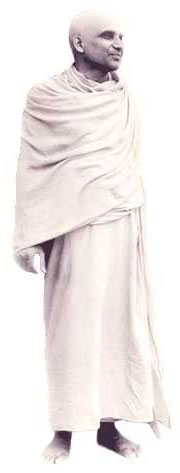
by Swami Krishnananda
The topsy-turvy, headlong falling of individuality into the sea of sorrow is actually an involvement of consciousness in externality and multiplicity. It is very important to know that you are involved in externality and multiplicity at the same time. Because of the externality in which you are involved, you appear to be a person like any other person in the world; and because of the multiplicity and the headlong aspect of the falling, you see the inside as the outside and the outside as the inside. God, who is Universal, appears to be an external object. Dont you think that God is somewhere, far away in heaven? While the Universal Being cannot be far away, the concept of God being transcendent and being extra-cosmic as the Creator of the cosmos, above space and time, is some fallacy that has been injected into your mind by the projection of space and time into your consciousness. And that has such an effect upon your own individuality that you think that you are somewhere cast in the world of space and time and there is a lot of distance between one thing and another. The idea of distance is the quality of space, and the idea of procession coming and going, even birth and death arises on account of the involvement of time. If space and time are only negations of the Ultimate Reality which is universal, in a way we may say the whole of creation is a negation of Truth.
"We live in a world of untruth," says the Upanishad very, very poignantly. We are involved in the untruth of our physicality, our individuality, our sociality, our isolation of ourselves from other things and the compulsion that we feel to see things only as present outside us. We are very much concerned with things outside and concerned very little with our own selves. When we open our eyes, we see only that which we are not. The Aitareya Upanishad briefly mentions to us, "A sorrow struck the individuals, as if a thunderbolt fell on them, and they cried and wept." When you lose yourself, you begin to cry. If you lose anything else, it does not matter, but if it is a question of losing yourself, you can imagine what it could be for you. Your sorrow becomes unimaginable when it is a question of the negation of your existence itself, but you would tolerate any other negation. "If all property goes, it does not matter, but why do I also go?" Here is a big question mark before you and, you have really gone. Therefore, you are perpetually in a state of anguish and agony in this world, and not a moment of peace can you have here. The reason is that the Universal, which is your real nature, has been obliterated from your experience and you see a false presentation of externality, division, and an inverted form of perception.
Allegorically, mythologically, in the fashion of an Epic or a Purana, the Aitareya Upanishad tells us that the individuals cried for food because they appeared to be dying of hunger. Here 'hunger' means the absence of the Universal Principle in the particular. To the extent to which the Universal is absent in our particular individuality, to that extent we are full of appetites hunger, thirst and what not. When we are hungry and thirsty, we are actually hungry and thirsty for the Universal which we have lost. But the fallen individual cannot expect to gain the Garden of Eden once again; as the Bible tells us, "A flaming sword is kept at the gate of heaven," so that we may not go back. What is given to us is only labour hard work, sweat and suffering, by which we appear to be somehow or other getting over the sorrow of this headlong fall.
So, food was given to us, and through the pranas we consume a diet of this food. Through the eyes we assume that we are eating something in the form of colours and visions. We will be very unhappy if we cannot see things. "Oh, he is blind! He cannot see." What does it matter if he does not see? It matters because a part of the diet of our sense organs has gone. Vision is a food, the sound that we hear is a food, taste is also a food, touch is a food, smell is a food. But this food cannot satisfy us for long. Every day we are hungry. If the food that is given to us today is actually satisfying, tomorrow we should not be hungry again. Why is it that we are harassed like this every day? Why is it that two or three times a day, hunger and thirst come upon us like demons? We seem to be living only to appease this thirst and hunger that appear to be catching hold of us as the very principle of death itself.
Thus, God gave food to the human individual in the form of an external something, of which we are having plenty in this world. But, are we happy? A curse has fallen upon us. God extradites the human nature from the heaven of angels, and mortality befalls us. Immortality vanishes from us. The immortal is our essential nature communion with God. We were with God; basically, we still are with God but we have lost the awareness of it. As in dream we completely forget what has happened to us in waking we project a new world altogether here, in this so-called long dream of waking experience, we have projected a world which is basically dream-like.
The Aitareya Upanishad tells us the Atman, the Universal Being which alone was, became the cause of the manifestation of this universe in this fashion: through the manifestation of the external space-time first, through multiplicity and through inverted compulsion of perception in respect of individuals. We cannot conceive of a greater tragedy. Even a concentration camp is better than this. The worst has befallen us. But we think we are still in heaven. Everything seems to be nice: the world is beautiful, society is good, friends are plenty, wealth is there. What is wrong with the world? The misconception has gone so deep into the very veins of our existence that we have started imagining that we are actually lords, like angels, though actually we are sunk in the hell of the negation of universal perception.
The yoga system is the science, the technique of the reversal of this process into which we have fallen through the process of creation. From the lowermost condition in which we find ourselves, we attempt to lift ourselves up systematically to the preceding condition. This is actually the inner meaning of the systematic enumeration of the stages of yoga that Patanjali Maharishi tells us, as yama, niyama, asana, pranayama, pratyahara, dharana, dhyana and samadhi. These rising from yama, etc., up to the point of samadhi are the stages in our return journey from the condition of the fall back up to the Absolute, which is the precondition of creation.
This is something about the Aitareya Upanishad. In the beginning of this series, I told you something about the doctrine of the Isavasya Upanishad: the pervasion of God in all things and the duty which is incumbent upon human individuals, the necessity to combine knowledge and action in our daily life, the need to see a harmony between God and the world, etc. In the Kena Upanishad, we were told that ultimately God does everything, and even the imaginary actions of ours are ultimately motivated by the Ultimate Being. We went up to the creation theory of the Taittiriya Upanishad which brought us into contact with the knowledge of the five sheaths. Then we went to the Mandukya Upanishad where we studied the involvement of consciousness in the five sheaths, objectively as well as subjectively, and today I have told you something about the Aitareya Upanishad.
Over and above what it has already told us about creation and the way in which we find ourselves in this world, the Upanishad goes into further detail of the reason why we are in this condition. Birth and death become a necessary result that follows from involvement in externality. What we call evolution in modern scientific language is the effort of the external to become the Universal. Every atom, everything living and non-living, is attempting to regain its universality. The whole world of externality is attempting to regain its universality. The world is craving for God, and every little atom of creation is crying for that which it has lost. The restlessness that we feel in this world, the kinds of agony of various types in which we are involved all these are explicable only as a manifestation of a basic sorrow, which is what has followed as a consequence of the loss of our own selves.
Atmanasha, Self-loss, has taken place. As you have studied already, the Self is universal in Its nature. Self-loss is actually the loss of the Universal Principle and if you lose the Universal, you have lost everything. There is nothing to hold on to afterwards. What can you grab, when the Universal has been lost sight of and escaped your notice? When you have lost the Universal, there is nothing with you afterwards. Everything has gone in one second. You are in the worst of conditions.
Birth and death follow. The rebirth of human individuality is nothing but the process of evolution accentuated in the human personality. What is called evolution is the cessation of one condition of things and the birth of the subsequent condition. If matter has to become plant, matter has to die first in order that it may become plant; if plant has to become animal, the plant condition has to die in order that the animal condition may come. So is the case if animal has to become man. All the preceding conditions must subside in order that the succeeding condition may arise. Thus, if a new condition, a new state of experience, has to be evolved in our own personality, the previous condition should be shed. The shedding of this previous condition is what is called death of the personality, and rebirth is nothing but the involvement of the very same consciousness in a succeeding condition.
As we move onward and forward, upward through the ascent of consciousness from the lower to the higher, we not only enlarge the dimension of our individuality on the one hand, but also the distinction that appears to be there between the outer and the inner gets diminished. The subject and the object, which are 'divided', come nearer and nearer until a merger of the Universal Subject with the Universal Object takes place. And all that took place vanishes, as a dream passes. The tragedy of birth and death is part and parcel of the consequence of the negation of Universality and the affirmation of individuality. Yoga is the way, and the knowledge of the various yogas has been introduced to you.