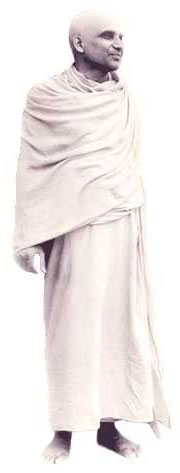
by Swami Krishnananda
It is space, time and causal relation which deal a death blow at our personality. The reason behind this phenomenon is, as mentioned earlier, that the universe does not behave in the way we behold it with our eyes or try to understand it with our mind. It is controlled by a law which is supernatural and beyond the comprehension of the logical intellect or the scientific understanding. What we call space and time—or, as people today say, space-time—is a mysterious complex in which we as individuals are involved. It is a network of relations. The space-time causal complex is a network of relations which surpasses the understanding of man. This network of relations cannot become the object of the understanding of man’s mind, because he himself is involved in these relations, just as a thread is involved in the network of a fabric or a piece of cloth. And just as a particular thread in a cloth cannot know the cloth unless it also knows itself simultaneously because of its inseparable relation to the entire structure of the cloth, in the same way, man cannot know that this is the case unless he knows himself and knows everything through himself and himself through everything.
This is the great difficulty before us. Here we seem to be entering into a field of a new type of education altogether, where to know oneself is to know all things and to know all things is to know oneself simultaneously. To know oneself is to know the whole universe, and vice versa. Thus, universal freedom and personal freedom mean one and the same thing because of the peculiar nature of the involvement of individuals in the space-time complex. Space and time are not outside us. We cannot see space, though we appear to be seeing it with our eyes. It is inwardly woven into the very fibre of our personality. There is space inside us also. Space is not outside anything, nor can it be said to be inside everything, because the very conception of a localised existence is impossible without the conception of space. What we call length, breadth and height is nothing but space defined in a particular manner. So when we say “I am occupying space”, we are not defining ourselves properly, because we are ourselves a configuration of space. The dimension of our body or personality is a local description of a point in space. And we are not merely in space—we are not only sitting here on this seat, in this hall—but also we are now at such and such time, on this day of the year, and so on. Therefore, we are in a locality of space and a point in time.
Hence, our involvement is not merely as a thread in a fabric or a piece of cloth, which is only to describe part of the mystery; we are also involved in a terrible illusion called the time process. No one can understand what time is. Time is not the movement of a watch or a clock. It is also not the recurrence of day and night. Even if the Sun were not to be there, there would be a time consciousness. Do we not feel there is time even in pitch darkness, when there is no light? So it is not wholly true that time is due to the revolution or the rotation of the Earth or the presence or the absence of light, like the light of the Sun. It is a mysterious way in which our mind itself works.
Time can ultimately be reduced to a state of consciousness of the succession of events in space. As space is involved in time and time is involved in space, we cannot know space unless we know space is now. So we have brought the time factor into our consciousness of space. “I am experiencing space now.” We are connecting the spatial extension to the time process in order to be aware that space is. And, we cannot be aware of time without space, because time is known by us as a succession of events which take place in an extension of space.
Thus, we are in a web of unintelligible relations, and being part and parcel of this network of relations, we are unable to know ourselves wholly, and are unable to know anything in this world. Outwardly we are ignorant; inwardly also we are ignoramuses. This is to say something about space and time.
But there is another difficulty of relationship, which ties us to the bondage of life. We are very happy when we see our friends and very grieved when we see our enemies. When a friend dies, we weep; and when an enemy dies, we say a good thing has happened. This is the manifestation of relationship. The whole of the life of man is nothing but an interpretation of relationship. Our possessions, our wealth, our family relations, and whatever we think is ourselves is nothing but a bundle of relations. Even that is unintelligible. We cannot know in what way a thing is connected with us. We have a piece of land and we say, “I am a landlord.” First of all, this land was there even before we were born. This is something we should not forget. So it is difficult to believe how it has become ours. Anyhow, we say, “It has been registered in my name.” What do we mean by ‘registration’? Nobody can understand what it is that we are thinking in our head when we say it has been registered. Again, some illusion is catching hold of our mind. By registration, we secretly mean that we have the consent of other people also in our imagining that this piece of land is ours. That is all that registration is. It means nothing else. Some person who is supposed to be representing other persons says it is our land. This is called registration in the District Registrar’s Office or Sub-registrar’s Office. There is nothing else in it.
The point is, the fact of other people accepting our notion that the land belongs to us does not explain the belonging of the land to us. The explanation has to come from the deep root—the grass roots—of the experience itself. In what way are we possessing this land? Is it under our grip? Are we holding it in our palm, carrying it on our head? It is difficult to say how it belongs to us. It belongs only in a peculiar movement of our head. A wave of the mind is concentrating itself on a consciousness of a relationship called possession. So land or no land, the joy of possession is only the consciousness of possession. If the consciousness is absent, the land may be there or may not be there, but it is not going to help us in any manner. We cannot eat this land. It cannot become part of our body. As a matter of fact, we cannot swallow any material which we regard as our possession.
In fact, possession is a concept; it is not a material occurrence. We cannot materially possess money, we cannot possess our wife and husband, we cannot possess children, we cannot possess anything. We can have no such connection except in a conceptual operation of our mind in a peculiar manner—whose essence we ourselves cannot understand. Here again we are in illusion, like the space-time complex.
The concept of relation is the essence of philosophical discussion. All philosophy of the East or the West is only a study of relationships—how one thing is related to another thing. The relationship of ‘A’ to ‘B’ is a distinction that is drawn between ‘A’ and ‘B’ together with a conception of the connection between ‘A’ and ‘B’. See how mysterious relationship is! If ‘A’ is connected to ‘B’, there should be a non-distinguishable connection between ‘A’ and ‘B’. If they are non-distinguishable, they become identical. If they are identical, there cannot be a relationship; and if they are really different, there cannot be a relationship. There is an illusion in the form of relationship. It does not exist, finally. But, it exists in the mind. Therefore, the mind is the maker of man, and the great gospel of the scriptures that the world is made up of mind, finally, has some sense.
Freedom from involvement in this space-time complex relationship is not possible. And why do we get into the clutches of birth and death? Now we come to the point. The world is evolving. The universe is in a state of process, and it is not stable on any permanent ground. It is moving, because the world is a name that we give to the externalisation of experience in space and time. And nature or God or anything that we regard as real is not an externalised something. It is a compact, integrated substance. It is Being—Pure Satta, as Sanskrit philosophers tell us—and division within this Pure Being is not conceivable.
The Ultimate Reality is indivisible; and the world is made up of divisible particles. Time is divided into minute bits of process, and space is again divided into minute bits of extension—and, therefore, the whole of the universe, constituted of its contents, is the opposite of Reality. The indivisible character of Reality is completely defeated in this divisible character of the world. The universe struggles to get back to this indivisibility of being. This effort of the universe to turn away from the divisibility in which it is caught, towards the indivisibility of its essentiality, is the process of evolution. As we are included in this process of movement, we are pushed onward with the world, together with its urge of movement, in the direction of the experience of indivisibility; and transformation takes place.
As we ascend further and further, move onward and onward, we have to put on newer and newer garments for the purpose of a newer and newer type of experience. Just as, if we want to see distant objects we use binoculars, if we want to see far-off things we use telescopes, and if we want to see very minute things we use a microscope, likewise, if we want to have an experience of a larger expanse of the indivisibility of things, we have to put on a new instrument of experience—which is a new body that we put on. With this body, we cannot have an insight into the inner structure of things—just as we cannot see the minute essentiality of things by looking at them with naked eyes. This is a gross instrument. This body, this mind, this intellect and any apparatus with which we are endowed at present are not subtle enough to gain entry into the inner structure of things. Therefore, the urge of the necessity to go inward towards the indivisibility of Reality compels us to cast off this instrument, as when we want to see a deeper reality we discard the old microscope and use a more powerful one.
Therefore, death is not a curse; it is a necessity under the circumstances. Death is comparable to the throwing off of this body. And birth is nothing but a consequence that follows the throwing off of the old microscope because it is not useful for the further adventure upon which we are embarking. The utilisation of a new instrument for the purpose on hand is the rebirth that we are taking.
Hence, death and birth of this body—or the process of metempsychosis, transmigration—is a continuous effort on the part of our inner core to cast off old instruments which are not useful for a higher purpose, and to utilise new instruments for gaining greater and greater insight into the higher realms of existence. No one can free oneself from these difficulties we call birth and death as long as one is finite. Birth and death are processes compelled upon the finitude of individuals, and this cycle ceases only when we cease to be finite. The urge of the finite towards the infinite is the reason behind the transformations we undergo through the processes called birth and death.
Thus, it is a cosmic need, a necessity under the circumstance in which the universe is working. No one can be free from this phenomenon because we are in the phenomenon of finitude. As long as there is something outside us, as long as there is space, as long as there is time, as long as we are one person related to other things outside us, as long as there is space-time causal relations, birth and death cannot be avoided.
But our struggle is towards the Infinite: to unite ourselves, in the state of yoga, to that Being of all beings, satya se satyam, where the finitude of our experience enters the infinitude of being, like rivers entering the ocean. Then, space-time relationship ceases. All our daily activities are also contributory factors to this great aim. What is the connection that seems to be there between this great, noble and sublime aspiration of the universe towards moksha and our little, tiny, brittle activities of day-to-day life? They are all groping in the dark in search of the exit from this world for a higher freedom. All our daily enterprises and works that we perform— whether we are a motorcar mechanic or a seller of vegetables and milk, a scooter driver or a clerk, whatever our occupation be—the sweat that we are shedding, the toil that we are undergoing, the work that we are doing, the suffering that we are passing through, the experiences of our life in any way are all little contributions that we unknowingly make to this great effort and purpose of the universe to achieve ultimate perfection.
Thus, there is nothing that we need in this world. We are asking for a thing of which we have no knowledge. Ignorantly we ask for that which is knowingly to be experienced. We are in a state of bondage because we are unconscious of the fact that we are unconscious of what is actually happening to us. The little joys and sorrows of life, the history of mankind, and the whole process of the cosmos are a great epic drama of the aspiration of the whole of creation for God-realisation.
As mentioned earlier, there is a great difficulty before us. All this is a grand aspiration, a great ideal before us, and we are throbbing and thrilled even to listen to these great possibilities which seem to be ahead of us. But we have little difficulties, little problems, little pulls which the Earth exerts upon us, to which I made reference yesterday. If you can succeed in reconciling this noble aspiration for the liberation of the spirit in God with the little duties of your life, you are a free man even here.
This is another subject, which is tantamount to a study of what usually goes as the practice of yoga. This has to be learned. Perhaps I have something to tell you about this technique that you have to employ from moment to moment in your daily life, by which you blend world and God together, and man and the Absolute walk together on the road as if they are friends going for a walk in the evening. This is a possibility. We shall have the opportunity to bestow contemplation on this noble subject.